The Transistor in a Century of Electronics
A Three Terminal Device
A transistor mounted on a metal can with three wires to each of the three terminals.
The transistor is a three terminal, solid state electronic device. In a three terminal device we can control electric current or voltage between two of the terminals by applying an electric current or voltage to the third terminal. This three terminal character of the transistor is what allows us to make an amplifier for electrical signals, like the one in our radio. With the three-terminal transistor we can also make an electric switch, which can be controlled by another electrical switch. By cascading these switches (switches that control switches that control switches, etc.) we can build up very complicated logic circuits.
These logic circuits can be built very compact on a silicon chip with 1,000,000 transistors per square centimeter. We can turn them on and off very rapidly by switching every 0.000000001 seconds. Such logic chips are at the heart of your personal computer and many other gadgets you use today.
Light Bulbs and Vacuum Tubes
Vacuum tubes were made containing several three terminal devices called triodes.
The transistor was not the first three terminal device. The vacuum tube triode preceded the transistor by nearly 50 years. Vacuum tubes played an important role in the emergence of home electronics and in the scientific discoveries and technical innovations which are the foundation for our modern electronic technology.
Thomas Edison's light bulb was one of the first uses of vacuum tubes for electrical applications. Soon after the discovery of the light bulb, a third electrode was placed in the vacuum tube to investigate the effect that this electrode would have on "cathode rays," which were observed around the filament of the light bulb.
Joseph John Thomson developed a vacuum tube to carefully investigate the nature of cathode rays, which resulted in his discovery, published in 1897. He showed that the cathode rays were really made up of particles, or "corpuscles" as Thomson called them, that were contained in all material. Thomson had discovered the electron, for which he received the Nobel Prize in Physics 1906.
Lee De Forest and The Radio
Radio brought information rapidly to the masses and was the first widely used electronic device in the home.
At the same time as physicists were trying to understand what cathode rays were, engineers were trying to apply them to make electronic devices. In 1906, an American inventor and physicists, Lee De Forest, made the vacuum tube triode, or audion as he called it. The triode was a three terminal device that allowed him to make an amplifier for audio signals, making AM radio possible. Radio revolutionized the way in which information and entertainment reached the great majority of people.
The vacuum tube triode also helped push the development of computers forward a great deal. Electronic tubes were used in several different computer designs in the late 1940's and early 1950's. But the limits of these tubes were soon reached. As the electric circuits became more complicated, one needed more and more triodes. Engineers packed several triodes into one vacuum tube (that is why the tube has so many legs) to make the tube circuits more efficient.
Early Computers
The largest computers based on vacuum tubes had racks and racks of tubes filling large rooms.
The vacuum tubes tended to leak, and the metal that emitted electrons in the vacuum tubes burned out. The tubes also required so much power that big and complicated circuits were too large and took too much energy to run. In the late 1940's, big computers were built with over 10,000 vacuum tubes and occupied over 93 square meters of space.
The problems with vacuum tubes lead scientists and engineers to think of other ways to make three terminal devices. Instead of using electrons in vacuum, scientists began to consider how one might control electrons in solid materials, like metals and semiconductors.
Already in the 1920's, scientists understood how to make a two terminal device by making a point contact between a sharp metal tip and a piece of semiconductor crystal. These point-contact diodes were used to rectify signals (change oscillating signals to steady signals), and make simple AM radio receivers (crystal radios). However, it took many years before the three terminal solid state device - the transistor - was discovered.
The First Transistor
The first point contact transistor made use of the semiconductor germanium. Paper clips and razor blades were used to make the device.
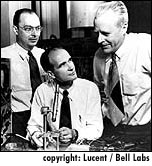
In 1947, John Bardeen and Walter Brattain, working at Bell Telephone Laboratories, were trying to understand the nature of the electrons at the interface between a metal and a semiconductor. They realized that by making two point contacts very close to one another, they could make a three terminal device - the first "point contact" transistor.
They quickly made a few of these transistors and connected them with some other components to make an audio amplifier. This audio amplifier was shown to chief executives at Bell Telephone Company, who were very impressed that it didn't need time to "warm up" (like the heaters in vacuum tube circuits). They immediately realized the power of this new technology.
This invention was the spark that ignited a huge research effort in solid state electronics. Bardeen and Brattain received the Nobel Prize in Physics, 1956, together with William Shockley, "for their researches on semiconductors and their discovery of the transistor effect." Shockley had developed a so-called junction transistor, which was built on thin slices of different types of semiconductor material pressed together. The junction transistor was easier to understand theoretically, and could be manufactured more reliably.
Limits of Individual Transistors
Individual electronic components were soldered on to printed circuit boards.
For many years, transistors were made as individual electronic components and were connected to other electronic components (resistors, capacitors, inductors, diodes, etc.) on boards to make an electronic circuit. They were much smaller than vacuum tubes and consumed much less power. Electronic circuits could be made more complex, with more transistors switching faster than tubes.
However, it did not take long before the limits of this circuit construction technique were reached. Circuits based on individual transistors became too large and too difficult to assemble. There were simply too many electronic components to deal with. The transistor circuits were faster than vacuum tube circuits, and there were noticeable problems due to time delays for electric signals to propagate a long distance in these large circuits. To make the circuits even faster, one needed to pack the transistors closer and closer together.
The Integrated Circuit
Integrated circuits placed all components in one chip, drastically reducing the size of the circuit and its components.
In 1958 and 1959, Jack Kilby at Texas Instruments and Robert Noyce at Fairchild Camera, came up with a solution to the problem of large numbers of components, and the integrated circuit was developed. Instead of making transistors one-by-one, several transistors could be made at the same time, on the same piece of semiconductor. Not only transistors, but other electric components such as resistors, capacitors and diodes could be made by the same process with the same materials.
For more than 30 years, since the 1960's, the number of transistors per unit area has been doubling every 1.5 years. This fantastic progression of circuit fabrication is known as Moore's law, after Gordon Moore, one of the early integrated circuit pioneers and founders of Intel Corporation. The Nobel Prize in Physics 2000 was awarded to Jack Kilby for the invention of the integrated circuit.
From the dawn of the vacuum tube triode, to the discovery of the transistor and the development of the integrated circuit, the 20th century has certainly been the century of electronics.
By Professor David B Haviland
First published 19 December 2002